
As described in a World Health Organization report on COVID-19, Chinese disease officials sent out more than 1,800 teams of epidemiologists with five people per team in Wuhan to track down the individuals that sick people may have come into contact with before they quarantined. A project underway at Oxford University wants to make that process instantaneous.
With universities all over the world looking to quickly move face-to-face classes online, massive open online course companies Coursera and edX have stepped in to offer access to their vast portfolios of course content.

Each year researchers at Carnegie Mellon University run a flu forecasting process to provide the Centers for Disease Control and Prevention with data that can help scientists understand timing, peak and intensity of that year's flu season, which typically runs from October through May. This year, however, at the request of the CDC, the researchers will stay on the job into summer since scientists don't yet know whether COVID-19 will follow the same cycle of subsiding as the weather warms up.
The country's largest community college system, Los Angeles Community College District, announced this week that it is moving as many courses as possible to online formats across its nine colleges, at least until April 13.

In the face of coronavirus, institutions large and small, public and private, two-year and four-year are canceling classes for the foreseeable future to reduce the likelihood of face-to-face interactions as much as possible.

Researchers at Augusta University are creating an app that will allow users to assess their COVID-19 infection risk at home in minutes, based on how they feel and where they've been.

The Centers for Disease Control and Prevention have issued interim guidance for higher education administrators on how to respond to coronavirus.
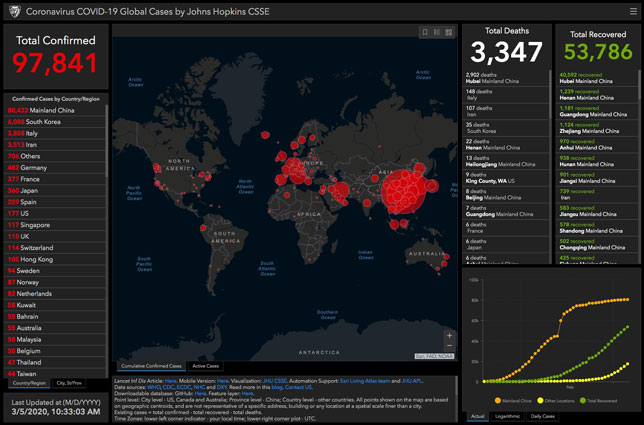
The Center for Systems Science and Engineering at Johns Hopkins University has developed an interactive, web-based dashboard that tracks the status of COVID-19 around the world.
To help institutions prepare for emergency situations such as a coronavirus outbreak, the Online Learning Consortium has put together a list of tools and advice for handling a quick shift to online courses.

While the physical campus at Xi'an Jiaotong-Liverpool University has been closed due to coronavirus (now referred to as COVID-19 by health experts), faculty have quickly adopted an online teaching platform to reach their students through remote instruction.