Blogging Student Life
- By Linda L. Briggs
- 04/22/06
Want a better way to get students involved in the campus
community? Start a college events blog.
ESTIMATES VARY WIDELY, but there’s no
disputing that there are millions of Web logs,
or blogs, out there—more than 100 million,
according to The Blog Herald, a blog site about blogs. Most blogs
are essentially public online diaries consisting
of dated entries with personal opinion and
commentary. The popularity of blogs soared
leading up to the 2004 presidential election
(when even presidential candidates like
Howard Dean joined the blogging bandwagon)
and they’re beginning to be considered a
more mainstream communication medium.
Given that popularity, can blogs be an
educational tool? Can they provide a way to
reach detached students who spend much
of their non-classroom time on campus
plugged into an iPod or on a cell phone? Ask
Mike Ho, who maintains a highly successful
blog—10,000 hits a week at an 8,000-
student community college—as program
advisor for Paradise Valley Community
College (AZ), one of 10 colleges in the Maricopa County
Community College District in metropolitan Ph'enix.
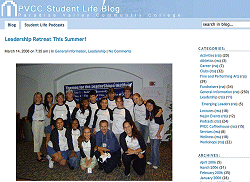
PARADISE VALLEY’s student life blog has become
an indispensable resource for students.
The Paradise Valley blog, launched in July 2005 and maintained by
Ho in about six hours a week, d'esn’t resemble the traditional
text-based blog. And it’s not about politics or personal
musings. Instead, it’s full of bright and colorful posterlike
announcements for student events and entertainment.
Ho’s office, the Student Life Center, is tasked with providing
(and informing students of) extracurricular activities
like concerts and speakers. He maintains the site using a
free blogging program called WordPress. It’s not difficult to use; Ho says he knew next
to nothing about blogs when his boss suggested launching
one to keep students apprised of campus activities.
Ho was already receiving numerous e-mail announcements
from various faculty, staff, and student groups daily
in HTML format, so posting the content in the blog, right
in that format, has proved to be simple.
Getting the word out about the Paradise Valley blog was
a challenge, however. Ho says it’s critical that the college’s
home page link to the blog, in order to make the blog easy
for students to find, and to indicate administrative support.
But word of mouth among students has also been useful in
promoting Ho’s site, as have links from other campus blogs.
The site launched to a few hundred hits a day (site traffic
numbers are tracked by the WordPress program) and
quickly grew to several thousand a day. The blog now averages
10,000 visits a week. The tracking mechanism reveals
that many students have the site bookmarked and come
there directly, presumably to quickly check what’s happening
on campus.
Free Blog Hosting
BLOGGING TOOLS aren’t something you need to pay for:
There are umpteen free blog-hosting sites, that allow varying levels of customization.
Among the options:
A simple Google search will turn up many more.
The WordPress software also includes the ability to post
Webcasts, which have been part of the Paradise Valley blog
experiment from the start. It’s a natural pairing: When a particular
musician or comedian is appearing on campus, for
example, Ho can include short audio or video clips of sample
content in the blog. He’s also experimenting with other content,
such as short faculty and staff interviews, and campus
announcements. Having seen students
all over campus sporting the
ubiquitous iPod earbuds, “we’re
trying out podcasting [announcements]
as a way of getting students
to listen in and pay attention
to what’s happening on campus,”
Ho says. Faculty and staff love that
aspect: Rather than sort through
endless e-mail, they can listen to
campus announcements in the
background, while they work.
Recording the announcements and interviews is simple:
Ho uses microphones connected to his PC, and edits the
recordings with free software called Audacity that allows him to add music tracks and edit
the content. But several students are needed to help with the
interviews, which can be time-consuming to edit.
The key to a good blog, Ho says, is freshness. He tries to
post new items as often as three times a day; a steady
stream of content is usually submitted by faculty members
or others who want to publicize an event. To stay up to
date on the design and content of other sites, Ho keeps an
eye on higher ed blogs like
the University of Illinois-
Springfield’s student life blog.
What’s next? Ho would like
to add software (also available
from WordPress) that lets multiple
people contribute to one
blog. With that in place, he
envisions students adding their
voices to the blog—perhaps a
daily “life as a first-year” diary
from a real student. The athletic department is also asking
for more sports-related podcasts—such as a Monday
recap of the weekend in sports at Paradise Valley.
It’s all part of the blog’s original purpose: to find ways to
get more students involved in campus life. Judging by the
traffic growth, it’s working.