S.A.T. Prep in Second Life: It's Social Once Again
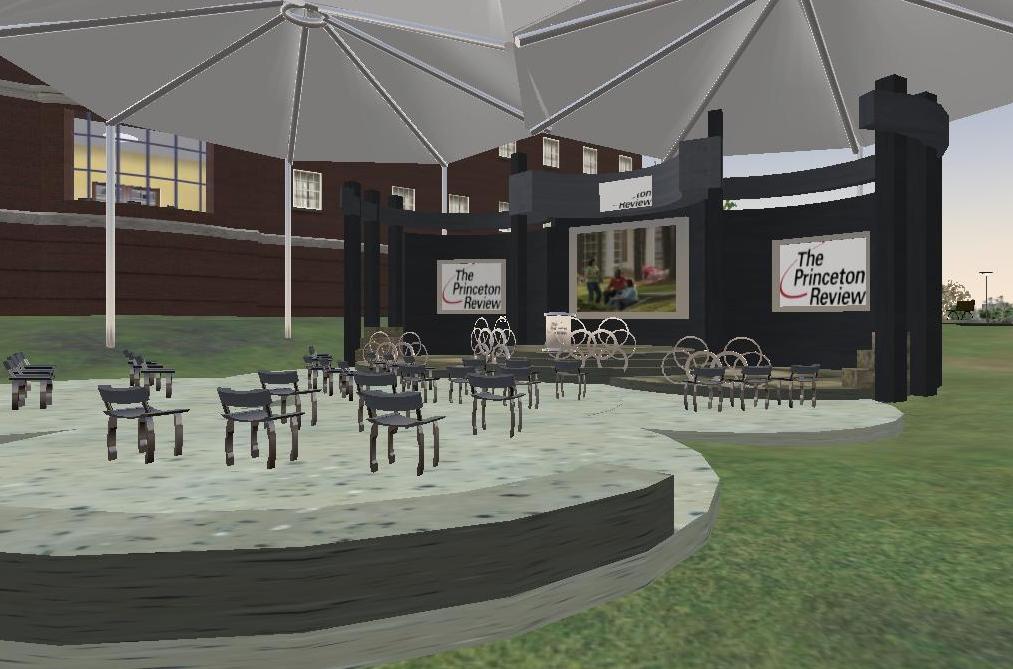
Colleges and universities are extending recruiting efforts and reach by offering new services to their admissions constituency during the years leading up to enrollment. Ohio University and the Princeton Review have added an interesting option to the "reach" of these services: a series of SAT strategy sessions in a Second Life site within the Ohio University island at Second Life. The Princeton Review,
www.princetonreview.com, already has its SAT
LiveOnline courses, and Ohio University already has an island and an expert Second Life (SL) developer, so this coming together of interests seems a natural outcome.
When you go to Ohio University's island in SL, you see what OU considers a close replica of the real bricks-and-mortar campus. That in itself has value for interested high school students who haven't yet visited the campus. The key question, of course, is what "value-add" there is in holding the SAT sessions in Second Life.
To see the OU SL site, you need to download the second life client to your own PC. Go to
http://secondlife.com and join. There is no cost to join or to download the SL client. Once within SL, there are many opportunities to spend money but you can explore SL without spending any money, including going to the OU site. Once you've logged in, click on the edit menu item "search," type in "Ohio University" when the dialogue box opens, scroll to and click on "Ohio University Second Life Campus," and then click on "teleport." Once at the island, you will get around most easily by flying rather than walking, even though you may bump into things. (No, you won't need first aid.)
You see in front of you your avatar. The avatar won't look like you unless you do a lot of re-design work, but it's easy to identify with that "person" anyway. It's very hard not to spend time exploring - you hear ambient sounds, see other avatars, enjoy the beautiful designs and maybe even meet a person. It's not exactly like being on the campus, of course, but it may be a psychological step up from using the Princeton Review's conferencing system in terms of imaginative presence and engagement.
The initiative sponsored by The Princeton Review and hosted at the Ohio University virtual site started in January with two sessions, the last one on January 31, 2008. They were called "SAT strategy sessions." High school students from Ohio, the country, and the rest of the world could attend. This was The Princeton Review's first venture into a virtual world. According to the Ohio University press release (
http://www.ohio.edu/outlook/07-08/January/260.cfm), Michael Reiss, Princeton Review's online marketing manager, worked with OU Engineering Professor Chang Liu, Director of OU's VITAL Lab (Virtual Immersive Technologies and Arts for Learning Laboratory) to launch the first strategy sessions.
The University chose the adult grid at Second Life to host the events. SL also has a "teen grid" but OU chose the adult grid because "the population of the adult grid is vastly larger than that of the teen grid." But, at the same time, Reiss said, "we have not ruled out the teen grid as a possibility in the future."
The most important outcome for the student attendees may be that, while at the OU island, they could talk with other attendees. SL adds a social element to online SAT preparation and to any event held in SL. Oddly, Second Life may be adding back the traditional face-to-face value of preparing for the SAT.
About the Author
Trent Batson is the president and CEO of AAEEBL (http://www.aaeebl.org), serving on behalf of the global electronic portfolio community. He was a tenured English professor before moving to information technology administration in the mid-1980s. Batson has been among the leaders in the field of educational technology for 25 years, the last 10 as an electronic portfolio expert and leader. He has worked at 7 universities but is now full-time president and CEO of AAEEBL. Batson’s ePortfolio: http://trentbatsoneportfolio.wordpress.com/ E-mail: [email protected]