Crestron Launches Single-Wire AV Network Hardware
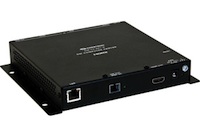
Crestron's DM-TX-201-S transmitter, part of the DigitalMedia 8G network series. |
Crestron has introduced a new series of AV network equipment that boasts a throughput of 8 Gbps when sending communications and AV signals over fiber or twisted pair cable.
The new series, the DigitalMedia 8G, is made up of four room controllers, two transmitters, and four input cards that send or receive AV, Ethernet, and control signals through a single line.
The room controllers consist of two fiber models, the DM-RMC-150-S and the DM-RMC-100-S, and two twisted pair devices, the DM-RMC-200-C and the DM-RMC-100-C.
The DM-RMC-150-S features two relay ports, a USB HID port for keyboard and mouse control, HDMI out, a COM port, RS-232, audio out, IR 1-2, and RJ-45 connections. The DM-RMC-100-S is similar to the DM-RMC-150-S but lacks the relay ports and USB connection.
Offering a built-in amplifier and HD scaler, the DM-RMC-200-C is small enough to mount into a two gang wall socket. It offers two relay ports, HDMI out, a USB HID port, and audio out.
The other twisted pair controller, the DM-RMC-100-C, features HDMI out, COM, IR 1-2, and RJ-45 ports.
All controllers offer RS-232 and Ethernet ports.
Also part of the new series are two transmitters, dubbed the DM-TX-201-S and the
DM-TX-201-C, both of which include a built-in switcher and signal converter.
The switcher enables the transmitters to change between HDMI and RGB inputs, while the signal converter changes S-video, composite video, and VGA into Crestron's DigitalMedia format.
With the use of fiber cable, the DM-TX-201-S sends signals to distances of about 1,000 feet. Its twisted pair cousin works with a shorter maximum range of 330 feet.
Both transmitters offer extended display identification data (EDID) format management and LED indicators for LAN, power, setup, reset, and AV input. Ports include RJ-45, DigitalMedia out, HDMI, USB HID, RGB in, and 3.5 mm (stereo minijack) audio in.
The input cards, which use a modular construction to fit in any of Crestron's seven DigitalMedia matrix switchers, offer HDMI and analog audio outputs, programmable audio control, EDID format management, and CEC control.
Two of the cards, the DMC-S-DSP and the DMC-S, work with fiber inputs, while the other two, the DMC-C-DSP and the DMC-C, use twisted pair cable.
Cards with the DSP designation feature audio breakaway and down mixing.
All of the controllers, transmitters and input cards support resolution up to 2,048 x 1,152 progressive or 1,920 x 1,080 interlaced.
DM-RMC-100-C, DM-TX-201-C, DMC-C-DSP, DMC-C are currently shipping. Further information is available here.
About the Author
Dan Thompson is a freelance writer based in Brea, CA. He can be reached here.