SmartDraw Updates 'Visual Processor'

Graphics software developer SmartDraw has released an update to its presentation tool, SmartDraw VP.

Billed as a "visual processor," SmartDraw VP provides tools that are designed to automate the process of creating visual elements, such as charts, calendars, and flow diagrams. These automated tools create and link the various elements of a chart through single-click or single-keystroke interaction. The software supports 70 types of visual elements, ranging from pie charts to floorplans. It also integrates with Microsoft Office, allowing users to bring their completed visual elements into PowerPoint, Word, Excel, or Outlook with the click of a button. Documents can also be shared through Microsoft Project.

The latest version, released this week, includes several new features and workflow enhancements, including document linking capabilities, which allow users to separate portions of complex visuals (such as detailed flowcharts) into individual documents that are hyperlinked to the original.

Other new features include:

  • Custom template categories for managing templates and creating custom categories for working with related templates;
  • A new Collections feature tat allows users to manage multiple documents as a single group, including sharing and printing those groups with a single command; and
  • Automatic saving and recovery of unsaved files.
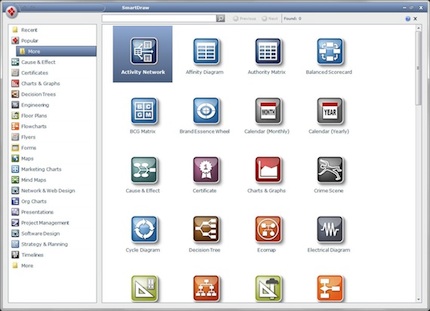
The SmartDraw VP September update adds new template capabilities, including the ability to customize template categories.

The new version of SmartDraw VP is available now. Student pricing starts at $99 for individual seats. Volume licenses are available for academic institutions. Further information on licensing options can be found here.

About the Author

David Nagel is the former editorial director of 1105 Media's Education Group and editor-in-chief of THE Journal, STEAM Universe, and Spaces4Learning. A 30-year publishing veteran, Nagel has led or contributed to dozens of technology, art, marketing, media, and business publications.

He can be reached at [email protected]. You can also connect with him on LinkedIn at https://www.linkedin.com/in/davidrnagel/ .


Featured

  • closeup of hands using smart phone

    Learning Continuity Built into the LMS Withstands Cloud or Cybersecurity Interruptions

    When your institution's administrative or instructional capabilities face disruption from natural, technical, or malicious events, what measures does your LMS offer to provide a "business as usual" operating and learning environment? Instructure's Ryan Lufkin comments on the LMS and learning continuity.

  • digital brain with network connections

    Microsoft Moving to Internally Developed AI Models in Office Apps

    Microsoft is reportedly using its own in-house artificial intelligence models to handle some workloads in Excel and Outlook, offering new evidence that the company is moving its AI strategy beyond model development and into large-scale cost reduction.

  • businessman holding tablet with holographic AI icons

    Google Moves AI Agents into the Mainstream

    At its recent I/O developer conference, Google presented artificial intelligence agents not as a distant research project, but as a product strategy spanning Search, personal assistants, productivity software, developer tools, and smart glasses.

  • artificial intelligence on laptop

    OpenAI to Combine AI Products into Desktop 'Superapp'

    OpenAI is reportedly developing a desktop application that would combine several of its emerging AI products into a single platform, according to reports, marking the latest step in the company's effort to transform ChatGPT from a standalone chatbot into a broader productivity and automation environment.