Kaplan Takes Education to the iPad
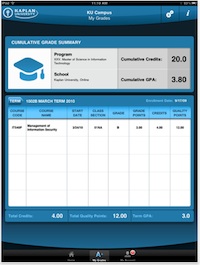
KU Campus for Apple iPad allows student to take their courses through the popular mobile device and participate in discussions.

Kaplan University has released a native iPad app that allows students to attend class through the mobile device.

KU Campus is an iOS-native app that Kaplan described as a "first of its kind" for a private-sector institution. With the new app, students can take their courses and access archived lectures, other course materials, activities, syllabi, links, and other information.

Kaplan University, a division of the Washington Post Co., serves more than 68,000 students online and through 11 physical campuses and six learning centers. The institution conferred more than 9,700 degrees in academic year 2009-2010 through 59 degree programs, 32 certificate programs, two diploma programs, and three law degree programs (this last via Concord Law School, a unit of Kaplan University).

Flexibility is a key to Kaplan's student population, most of whom are working adults and adults who have to care for their families. Fifty-five percent are older than 30. Eighty-eight percent take courses online.

"This application is a milestone in Kaplan University's commitment to delivering high-quality educational options to students who value the flexibility of an online format," said Gregory Marino, president of the Kaplan University Group, in a statement released today. "Our mission is to help our students succeed in every way possible. By offering technological innovation and continuous accessibility, we can accomplish this in ways yet to be achieved by others in the sector."

In addition to access to online courses, the app also offers:

  • Discussion boards for collaborating with students and faculty;
  • Access to financial aid information, including payment details, charges, information about scholarship, and other materials; and
  • Notifications.

KU Campus requires an iPad and supports iOS 3.2 or later. Additional details can be found on iTunes or on Kaplan's online learning portal.

About the Author

David Nagel is the former editorial director of 1105 Media's Education Group and editor-in-chief of THE Journal, STEAM Universe, and Spaces4Learning. A 30-year publishing veteran, Nagel has led or contributed to dozens of technology, art, marketing, media, and business publications.

He can be reached at [email protected]. You can also connect with him on LinkedIn at https://www.linkedin.com/in/davidrnagel/ .


Featured

  • abstract smartphone translucent screen displaying AI interface

    Apple Introduces Redesigned Siri AI

    At its recent Worldwide Developers Conference, Apple introduced Siri AI, a redesigned version of its voice assistant that Apple describes in its own announcement as "a profoundly more capable and personal assistant." The update is intended to make Siri more conversational, more context-aware, and more useful across iPhone, iPad, Mac, Apple Watch, and Vision Pro.

  • digital data protection and cyber security

    White House Launches New AI Security Framework

    President Donald Trump has issued a new executive order aimed at maintaining United States AI leadership while addressing the security risks posed by increasingly powerful AI systems.

  • Glowing route lines merging into single gold pathway

    Microsoft Merges Copilot Apps Into a Single User Experience

    Microsoft recently announced it is consolidating its consumer Copilot app and Microsoft 365 Copilot app into a single destination, addressing a fragmented product strategy that has required users to navigate separate applications for AI chat and productivity tools.

  • VSLive! session

    VSLive! San Diego 2026 Puts AI at the Core of the Campus IT Stack

    For higher education IT teams working through AI pilots, ERP integrations, student-facing apps, analytics projects, and mounting security concerns, Visual Studio Live! San Diego 2026 offers a look at the development practices that are shaping the campus technology landscape.