Cisco To Ship Virtual Desktop Clients with Enhanced Voice and Video
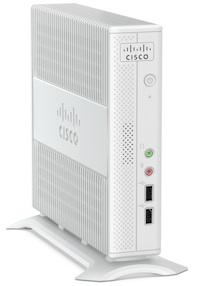
Cisco VXC-series endpoints are designed to provide high-quality voice and video in virtual desktop environments. |
Cisco has debuted two new Cisco Virtualization Experience Client (VXC) endpoints that enable high-quality voice and video in virtual desktop environments. The new endpoints are the VXC 6215 and the VXC 4000. They are part of the next phase of Cisco's Virtualization Experience Infrastructure (VXI), which delivers open, validated virtual workspaces that integrate virtual desktops, voice, and video across Cisco's network-based architectures.
The VXC 6215 is a Linux-based thin client with an optional firmware upgrade that enables voice and video-processing capabilities. It supports virtual desktop infrastructure (VDI), voice, and video services with Citrix XenDesktop and VMware View.
The VXC 4000 is a software appliance that transforms a traditional PC into a media-capable virtual desktop client. The VXC 4000 can access enterprise applications and data virtually and provide access to real-time collaboration capabilities using local media processing on the PC. The VXC 4000 works with Citrix XenDesktop and VMware View on Windows XP or Windows 7 desktops.
Cisco claimed that because the virtual desktop environments support direct point-to-point communications between devices, they reduce bandwidth consumption and latency issues, improve voice and video clarity, and facilitate online collaboration.
The Cisco VXC 6215 will be available for order in the fourth quarter of 2011 and should be globally available in the first quarter of 2012. A voice-supported version of the Cisco VXC 4000 should be globally available in the fourth quarter of 2011.
In related news, Cisco has announced a number of tools and services for security, data center infrastructure, and end-to-end services, including:
- Support for virtualized environments on Cisco Identity Services Engine (ISE), a security enforcement appliance that monitors the types of devices accessing the network, the information available to them, and whether they are inside or outside the firewall;
- Improved desktop scalability and performance through the Cisco Unified Computing System (Cisco UCS) platform, providing double the fabric capacity, quadruple the bandwidth to the server, 40 percent reduction in latency, and over 500 percent increase in the number of virtual desktops supported in a single UCS management domain;
- Cisco Validated Designs (CVDs), which provide an end-to-end blueprint for designing workspace solutions; and
- Cisco Allied Services for VXI and Cisco Optimization for VXI Service.
Cisco ISE and Cisco Optimization for VXI Service are available now. Cisco CVDs and Cisco Allied Services for VXI should be available in the fourth quarter of 2011.
About the Author
Leila Meyer is a technology writer based in British Columbia. She can be reached at [email protected].