In Yearly LMS Count Canvas Gains, Blackboard Learn Loses
- By Dian Schaffhauser
- 10/14/14
Even though support for the Angel learning management system will not officially end this month (Blackboard rescinded its decision to retire the legacy LMS in 2012), plenty of institutions are apparently seeing the writing on the wall and jumping ship anyway. According to data compiled by Edutechnica.com, Angel has lost 39 institutional customers in the United States. During that same period Blackboard also lost 31 Blackboard Learn LMS customers. The only clear winner during the year has been Instructure, which gained 66 new institutional users, nearly making up the loss for the other two learning management systems (LMS).
Edutechnica is a blog site maintained by George Kroner, a former Blackboard development manager and currently an enterprise solutions architect at the University of Maryland University College.
In 2013 Kroner undertook a study to track adoption of educational technology, with a focus on LMS usage to start. Using multiple sources, such as open data sets from the United States Department of Education and comparable resources in Canada, the United Kingdom and Australia, the researcher compiled a dataset of universities, including their enrollments and URLs. Then he hunted down the primary LMSs in use in each of those institutions that had enrollments greater than 2,000. Besides Blackboard and Canvas, the LMSs that earned individual attention also included D2L, Moodle and Sakai; everything else fell into either "Legacy" or "Other" counts.
A year later Kroner revisited the data to do an equivalent comparison; that's where the numbers above come from. But he also refined it to examine LMS usage in institutions with greater than 800 full-time enrollments. As he noted in a previous blog post, "Three-quarters of all recognized higher education institutions in the United States have fewer than 2,500 FTE — a critical demographic as the majority of universities in the U.S. are of this size or smaller. To more fairly represent LMS usage, we needed to include data on smaller schools."
As he noted, "the data that encompasses smaller institutions tells a very different and more complete story that reflects a truer representation of LMS usage." For example, the greater the number of institutions included in the count, the less of a marketshare Blackboard holds — 33.5 percent for institutions with more than 800 students vs. 42 percent for schools with more than 2,000.
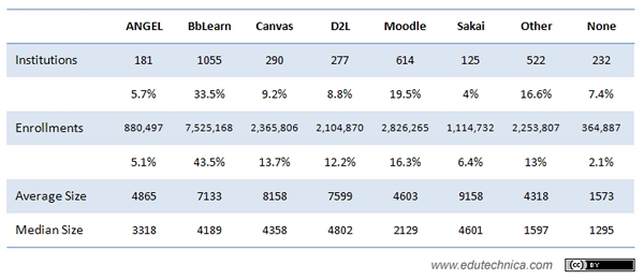
Also, Moodle and "other" or alternative LMSs have a much stronger showing among smaller colleges. Moodle, for instance, jumps from 339 schools with enrollments greater than 2,000 to 614 when enrollment is higher than 800.
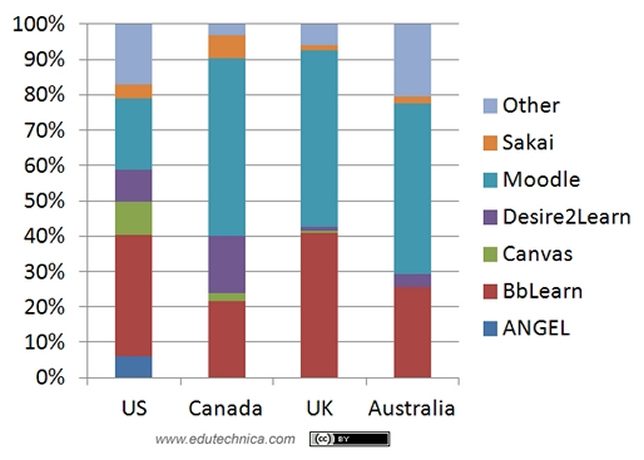
In examining LMS marketshare across the four countries for which he gathered data, Kroner pointed out that from 2013 to 2014 Angel usage shrunk in all countries while Moodle usage grew. He also observed that "Canvas has not taken off overseas in the same way that it has in the U.S."
About the Author
Dian Schaffhauser is a former senior contributing editor for 1105 Media's education publications THE Journal, Campus Technology and Spaces4Learning.