Carnegie Mellon's Andy Priming for Moon Cruise
- By Dian Schaffhauser
- 12/17/14
A $30 million Google Lunar XPrize has just doled out its first two monetary prizes on the mission to place a robot on the moon and explore its surface. Carnegie Mellon University is one of the beneficiaries.
The organization has awarded a $500,000 "milestone prize" to Carnegie Mellon and its development partner Astrobotic Technology (a university spin-off) in the "Mobility" category as well as $250,000 specifically to Astrobotic in the "Imaging Subsystem" category. Additional milestone awards will be announced in January.
The overall competition will go to a privately funded team that can place a robot on the moon to explore at least 500 meters of the surface while transmitting high-definition video and images back to Earth.
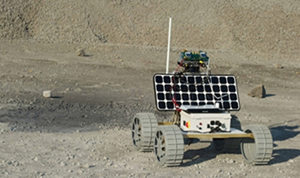 Carnegie Mellon's "Andy" (named after university founder Andrew Carnegie and funder Andrew Mellon) took the mobility milestone prize as the only robot among the competing teams that met development benchmarks for "flight readiness." The technical expertise to develop Andy came out of multiple disciplines, including computer science, engineering, fine arts and science.
According to Andy's Web site, the land rover robot will visit a moon pit in the region known as Lacus Mortis or "Lake of Death," to explore for signs of water and sources of fuel as well as caves that could be habitable by humans.
Andy's features include:
- A weight of 73 pounds (that's 12 pounds on the moon), a ground clearance of about seven inches and a 4:3 aspect ratio for stability and a low center of gravity. That configuration is expected to help the rover maneuver up 30-degree slopes and over rocks up to six inches in size;
- The speed of each of Andy's four wheels can be set independently to allow the rover to turn in place, "like a tank";
- Electric motors and other systems have been built to withstand the extreme temperatures and radiation exposure of the moon; and
- The software combines landing imagery with 3-D path reconstruction data to plan and document Andy's exploration route.
"Andy has proven to be a tough, smart, sure-footed machine," said William "Red" Whittaker, professor of robotics, who is leading a team of about 50 people — students, faculty and staff — in the creation of the rover. "We've shaken it to simulate launch forces, driven it through moon dirt and exposed it to the extremes of lunar temperatures among many, many tests. Our team and our machine faced a rigorous evaluation by world-class judges and came out on top."
He noted that the prize money will be used to continue Andy's development.
Astrobotic is developing commercial hardware and services to support space exploration initiatives. In addition to imaging technology that will be used on Andy, the company is also developing a landing craft to deliver the rover to the moon. The ultimate goal for the Carnegie Mellon Robotics Institute spin-off is to create a commercial delivery service, akin to UPS for space, to handle satellite servicing, off-Earth mining, space tourism and NASA-contracted exploration and science.
XPrize representatives also said that the organization has extended its deadline for the competition to the end of 2016. By the end of 2015, however, at least one team must provide documentation of a scheduled launch in order for all of the teams to move forward in the competition.
"The award of these Milestone Prizes is evidence that the partnership between Astrobotic and Carnegie Mellon is powerful and that our technologies are setting the pace for the Google Lunar XPrize teams," said John Thornton, Astrobotic's CEO. "We feel confident that we can land on the moon in 2016 and show that a private company can set the course for future lunar exploration."
About the Author
Dian Schaffhauser is a former senior contributing editor for 1105 Media's education publications THE Journal, Campus Technology and Spaces4Learning.