Only 16 Teacher Prep Programs Ranked as 'Top Tier' in New Report
- By Dian Schaffhauser
- 05/16/17
Lesser-known Hope College in Holland, MI; Lipscomb University in Nashville, TN; Messiah College in Grantham, PA; and St. Olaf College in Northfield, MN surface on a shortlist of the best undergraduate programs for preparing high school teachers, alongside Arizona State University, the University of Iowa and the University of Minnesota. What puts them there? According to the National Council on Teacher Quality, each has "solid admission standards, provide sufficient preparation in each candidate's intended subject area and show them how best to teach that subject." Many also do well in teaching future teachers how to manage a classroom and in providing high quality practice opportunities.
The complete list is only 16 schools long out of a possible 717 undergraduate programs that prepare secondary teachers. Half of the programs recognized by NCTQ are public, half are private. Programs range in size from Ohio Wesleyan University, which graduates about 20 teachers a year, to Arizona State, which graduates over 800 teachers a year. In-state tuition for the undergraduates ranges from under $7,000 a year at CUNY-Hunter College to a high of just over $44,000 at Ohio Wesleyan.
The NCTQ's latest report, "Landscapes in teacher prep: Undergraduate secondary," found that a widespread problem among the programs knocked off the list were a lack of content preparation for science and social studies teacher candidates. For example, even though history is the subject most social studies teachers will be assigned to teach, one out of five programs requires minimal to no history courses for their future teachers. However, they almost universally deliver strong preparation in English and mathematics.
The study examined programs and policies in three primary areas: knowledge in the sciences and social studies; practices pertaining to teaching methods and student teaching with a focus on classroom management; and college selection criteria for admissions.
Other findings shared in the report:
- Only four in 10 programs (44 percent) expect their teacher candidates to show the "most effective strategies" for managing their classrooms while doing student teaching;
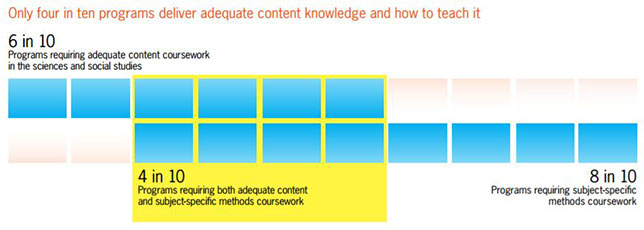
- A similar number (42 percent) teach future teachers both the content and the teaching methods for their subject; and
- A mere 6 percent of programs have expectations that future teachers will be mentored only by skilled teachers and require regular observations by program staff.
The report also offers recommendations for improving teacher programs:
- First, review the report card issued to each program to understand the areas of strength and weakness;
- Second, raise the subject content requirements to make sure teacher candidates receive a "solid education" in every subject they'll be licensed to teach, including in the broad categories of science and social studies;
- Third, push states to impose requirements on new teachers to pass licensing tests in every subject they'll be teaching rather than relying on an average across tests;
- Fourth, encourage school districts to leverage the influence they have with the institutions doing the training by hiring teachers only from those programs that are top-scoring, thereby pressuring local prep programs "to improve and better prepare new teachers."
"States, schools, and leaders of teacher preparation programs have the ability to demand higher-quality preparation for future teachers by instituting subject-specific tests or perhaps even limiting the use of multiple-subject teacher certifications," the report's authors concluded. "They also can change the selectivity, content requirements, oversight of student teaching, and provisions for method courses of the programs themselves."
The teacher preparation program report is openly available on the NCTQ website here.
About the Author
Dian Schaffhauser is a former senior contributing editor for 1105 Media's education publications THE Journal, Campus Technology and Spaces4Learning.