2U Updates Partnership Model with Stackable Revenue Share Options
2U, parent company of online learning platform edX, has revamped its partnership model, moving from a one-size-fits-all offering to a variety of revenue-sharing options that enable universities to select stackable bundles of technology and services to meet their needs.
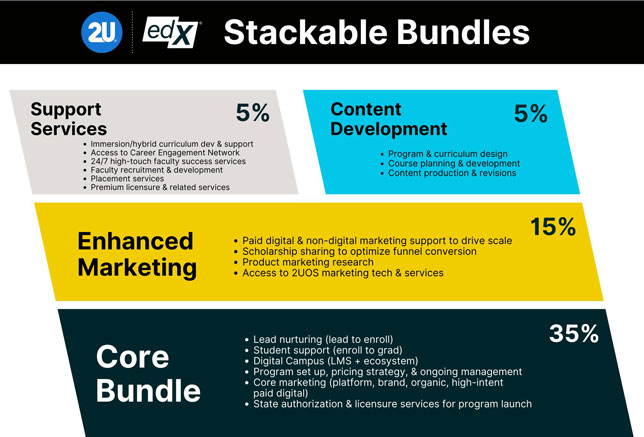
The options begin with a Core Degree Bundle: For 35% revenue share, institutions receive program design and management, access to the edX marketplace, organic marketing, prospect nurturing, ongoing student support, and 2U's Digital Campus and data analytics ecosystem. Universities can opt to enhance the core bundle with additional services, comprising enhanced marketing (15% revenue share), content development (5%) and specialized support services (5%).
"Rice has been a long-term collaborative partner of both edX and 2U. We have found both organizations willing to flexibly engage with us on a range of issues as the world of online education evolves," commented David Leebron, former president of Rice University, in a statement. "I believe 2U's adoption of increasingly flexible arrangements in its partnerships will ultimately serve both students and universities well, and will foster an increased variety of student options that will open more opportunities to students from diverse backgrounds and at different points in their life and educational trajectories."
Among the first institutions to sign on with the new partnership model is the Wisconsin School of Business at the University of Wisconsin-Madison, which is launching an online master's degree program in business analytics as well as a Fundamentals of Business MicroMasters program.
In addition to the new stackable offerings, 2U and edX are introducing incentives to encourage new and existing partners to lower the cost of their online degree programs. For any degree partner that agrees to significantly reduce online tuition, 2U will reduce its share of program revenue, the company said in a news announcement.
"While 2U and edX's university partners have sole responsibility for setting tuition rates for the 180+ online graduate degree programs the company supports, there is a common misperception that the company benefits financially from more expensive tuition," the announcement explained. "But in reality, the higher the tuition, the more expensive it is for 2U to market a program and attract students. As tuition goes up, student demand goes down, which leads to even higher marketing costs that are shouldered by 2U under its partnership model, not the university. Data clearly shows that tuition reductions remove one of the largest barriers to educational attainment, enabling more qualified learners to enroll and achieve their goals."
"As we embrace our future as a platform company under the edX brand, we're taking bold and important steps to support our university partners in transforming their institutions, expanding access, and helping bring down the cost of higher education," said 2U Co-Founder and CEO Christopher "Chip" Paucek. "Higher education is at an inflection point, with learners demanding more flexibility and better ROI. 2U and edX strongly believe that greater affordability is better for students, better for universities, better for the company, and critical to the future of higher education."
About the Author
Rhea Kelly is editor in chief for Campus Technology, THE Journal, and Spaces4Learning. She can be reached at [email protected].