CT Briefs
:: NEWS
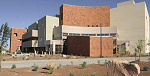
THE COLLEGE OF SOUTHERN
NEVADA met phenomenal growth
head-on with a new help desk.
JUST SAY HELP DESK.
Enrolling more than 80,000
students annually and experiencing
up to a 25 percent
annual growth rate in recent
years, the College of Southern
Nevada needed a help
desk that could keep on top of
both high volume and change.
Just over a year ago, the
school outsourced its help desk requirements
as part of a major SunGard Higher
Education contract to manage its IT, going from
virtually no help desk services to 24/7
services that answered more than
25,000 requests in that first year.
LIBRARY SUPPORT FOR
eSCIENCE. The Association of
Research Libraries has
made available the report, "Agenda for
Developing E-Science in Research
Libraries." The publication
focuses on opportunities for engagement
of the library community in light
of trends in eScience and eResearch,
and considers data curation, infrastructure
systems, policies for data and
research dissemination, and more.
VIRTUAL WORLDS GAINING
GROUND. Despite his initial skepticism,
in 2007 Jean-Claude Bradley,
eLearning coordinator for Drexel
University's (PA) College of Arts and
Sciences and an associate professor of
chemistry, helped establish Drexel
Island in Second Life. Since then, he's used it in his
Introduction to Organic Chemistry
class and has blogged extensively
about its benefits and drawbacks.
Read CT's exclusive interview here.
EXPANDING THE GLOBAL
CAMPUS. The University of
Illinois is powering its latest online
initiative using Desire2Learn's electronic learning
solutions, including the Enterprise
eLearning Suite and the D2L Learning
Environment. U of I's Global Campus
offers bachelor's completion programs,
master's degrees, and certificate programs. Read more here.
SOUND DIRECTIONS.
Researchers at Harvard University (MA) and Indiana University have
published the results of two years of
research, "Sound Directions, Best
Practices for Audio Preservation" The 168-page
publication will resonate with experts
in audio engineering, audio preservation,
and digital libraries, and includes
best practices in and explorations of
existing and emerging standards.
SERVING UP eBOOKS. The
University of Toronto (Canada) has
licensed Ebrary's
eContent technology on behalf of the
Ontario Council of University Libraries, to archive and
distribute more than 100,000 eBooks
through OCUL's Scholars Portal.
:: PEOPLE
NEW CTO AT U PUGET SOUND.
Next month, Molly Tamarkin will
become chief technology officer at
the University of Puget Sound (WA). She leaves her post as Duke
University's (NC) associate dean of
arts and sciences for information
science and technology. Read
more here.
WGU APPOINTS NEW CTO.
Dave Wilson has been named chief
technology officer for Western
Governors University (UT). Wilson's
career spans more than 20 years
in application design, software
engineering, and IT.
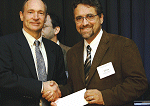
LOMBARDI (right) receives
MATC award
from Berners-Lee.
MELLON AWARD FOR DUKE.
Julian Lombardi, assistant VP for
academic services and technology
at Duke University, accepted an
award of $100,000 from the Andrew
W. Mellon Foundation, for Duke's leadership and
development work in advancing the
Croquet environment in open source. Croquet
allows developers to create and link
collaborative cross-platform multiuser
2D and 3D applications and
simulations. The award, presented
by World Wide Web inventor Timothy
Berners-Lee, was one of 10 Mellon
Awards for Technology and Collaboration
(MATC) given for 2007.