Facilities of the Future
The bricks-and-mortar infrastructure of community colleges has not nearly kept pace with increases in student enrollments.
- By Jennifer Grayson
- 12/01/09
Not only are
colleges bursting at the proverbial
seams, but, according to the American
Graduation Initiative, many
two-year institutions "face large
needs due to deferred maintenance
or lack the modern facilities and
equipment needed to train students
in technical and other growing
fields. Insufficient classroom space
can force students to delay needed
courses and reduce completion
rates." As part of the initiative,
President Obama is proposing a
new $2.5 billion fund to catalyze $10
billion in community college facility
investments that will "expand the
colleges' ability to meet employer
and student needs." One Illinois
community college is already fixing
its focus on the future, revamping its
classrooms to provide top-notch
training for 21st century jobs.
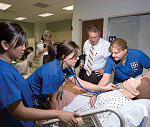
Harper College's virtual hospital unit
THE DESIRE TO "DO SOMETHING THAT COULD BE ON THE CUTTING EDGE" of jobs
training led Chicago-area Harper College to renovate 4,360 square feet of existing shell space in its Avanté Center for Science,
Health Careers, and Emerging Technologies into a laboratory for its degree program in nanotechnology, says Sally
Griffith, assistant vice president for career programs. "As a college, we were looking to get into something that was an
emerging technology, and nanoscience goes across all of the sciences." The science has applications in numerous industries,
including manufacturing, biotechnology, and healthcare, and is proving particularly relevant to the new greencollar
work force. Nanoengineering is being used to develop alternative fuels, including ethanol, low-cost LED lighting,
and coating for super-efficient solar panels. As such, the demand for skilled technicians is high: The National Science
Foundation estimates the industry will create 2 million new jobs by 2015.
Harper's two-year degree in nanotechnology, which launched in the fall of 2008, is the first such program offered by a community
college in the state of Illinois. The new space, completed this fall, is a state-of-the-art nanoscience lab, complete with
a Hitachi scanning electron microscope, an NT-MDT atomic force microscope, and a device that allows students to lay down
nanoscale layers of material. Having such sophisticated technology in the classroom allows students to collaborate with local area
companies that are incorporating the "tiny science" into some pretty profound work. "We're working with a company close
by here that is developing very tiny little motors that will carry medication to the spot on somebody's body that needs it. Can
you imagine if you did chemotherapy just to the part that needed it rather than poisoning a whole body?" marvels Griffith.
Walking the Walk
 "ANOTHER KEY TECHNOLOGY piece to
consider is simulations in the sciences.
We just cannot open enough seats in traditional
labs. The high cost of good labs is
not only space and
equipment, but also
providing for materials
and safety. If we could
get a sufficient body
of simulations based
on good principles of
instructional design,
simulations that students
could do any place, any time-- not
in a dedicated science lab-- the students
would probably learn more science and
we could actually expand the number of
students we work with while saving costs."
"ANOTHER KEY TECHNOLOGY piece to
consider is simulations in the sciences.
We just cannot open enough seats in traditional
labs. The high cost of good labs is
not only space and
equipment, but also
providing for materials
and safety. If we could
get a sufficient body
of simulations based
on good principles of
instructional design,
simulations that students
could do any place, any time-- not
in a dedicated science lab-- the students
would probably learn more science and
we could actually expand the number of
students we work with while saving costs."
-- Steven Sachs, vice president, instructional
and information technology, Northern Virginia Community College
The facility does have some limitations, however. Harper can't match the research power of a huge research university,
admits Griffith, which is why the nanotechnology lab was designed as a smart classroom, complete with capabilities for multimedia,
online learning, and remote collaboration with other institutions. Harper students can even operate equipment located
at Penn State and the University of Minnesota, virtually. (UM is a partner in the National Science Foundation grant that
Harper received to launch nanotechnology in the Midwest; the other grant partners include Dakota County Technical College [MN], Chippewa Valley Technical College [WI], Lansing Community College [MI], North Dakota State College of Science, and Minnesota State Community
and Technical College.) "Students
can send a sample in [for testing in
labs at Penn State or UM] and watch
what happens on a video camera," says
Samuel Levenson, assistant professor
and nano-science coordinator at Harper.
In addition, Team-Viewer remote-access
software allows students at partner school
College of Lake County (IL) to access
the instruments at Harper.
Simulations for Students
Biotech isn't the only area predicting
massive job growth. According to the
Bureau of Labor Statistics, employment
for registered nurses is expected to grow
faster than all occupations and generate
the largest number of new jobs for any
field. That's why Harper has also focused
attention on its nursing program, which is
in the final stages of a renovation to create
a virtual hospital for its students.
When Harper lab and simulation
coordinator Barbara Gawron proposed
recreating a hospital unit at the school--
complete with nurse's station, patient
rooms, designated specialty areas, and
talking mannequins (called simulators)--
Cynthia Luxton, dean of the
health careers division, jumped at the
idea. In a typical nursing school scenario,
explains Luxton, you walk into a
large, open lab where different equipment
is available to students. "It's not
what they're going to do when they walk
into a patient's room at the hospital."
Harper nursing students already use
simulations in all four semesters of the
Associate Degree Nursing program-- the
faculty even use it for pre-program testing
to ensure students are competent in
certified nursing assistant skills-- so by
making the experience even more realistic,
the department hopes to truly engage
its students. The new space will be multi-disciplinary;
students in other medical
technician programs (ultrasound, general
diagnostic, graphic technology) also will
use the new virtual hospital for training.
The physical renovation of the space
will mostly involve constructing wall
dividers to create the look and feel of a
real hospital. What will require the most
work is integrating all the new technology
into the space. In addition to Laerdal
and Gaumard simulators which, depending
on the level of model purchased, can
even be used to draw blood and check levels,
the new virtual hospital will include a
computerized system for charting medical
records, nursing call lights, videotaping
so that instructors can see students
work during simulations, iPod Touches
used as clinical-reference tools, and a
Pyxis computerized medication-administration
system from CareFusion.
"Students are going to walk into a
space that looks just like a hospital,
because we want them to make decisions,
we want them to problem-solve; and if
they do make a mistake, it's going to be in
a safe environment, rather than [in] a clinical
area that's very busy and hectic," says
Gawron. "We can control the situations
and what they're going to encounter."
One advantage of this regulated environment
is that instructors can design simulations
to mimic what's happening in
society. "I could totally see that we could
have an H1N1 epidemic in our hospital,"
says Gawron. "What we're seeing trendwise
we can replicate right away."
It's this trailblazing technology that
regularly brings larger schools to visit
Harper. But Harper College President
Kenneth Ender emphasizes that atomic
force microscopes and robotic patients
alone aren't enough to prepare students
for 21st century jobs. "It is paramount
that we not only acquire the latest technology,
but also work to thoughtfully
integrate it into all levels of our curriculum.
How we use these resources is just
as important as acquiring them."