Study: Online Learning May Not Solve the College Affordability Problem
- By Dian Schaffhauser
- 03/12/19
Could online learning help institutions provide a lower-cost education to more students? That's a question that Richard Garrett, Eduventures chief research officer, examined recently in a brief on the Encoura website. According to a 2019 study on "published tuition," fully online institutions "charge the least" at both the ungraduated and graduate levels — and the price has gone down as the number of students enrolled in these programs has gone up.
A common assumption, Garrett pointed out, was that an online program was less expensive to produce than one offered face-to-face; after all, there's no physical campus and there are the opportunities for "economies of scale." However, a WICHE Cooperative for Educational Technologies (WCET) survey done in 2017 put the kibosh on that, finding that quality online instruction is "often more time-consuming and expensive than the in-person norm."
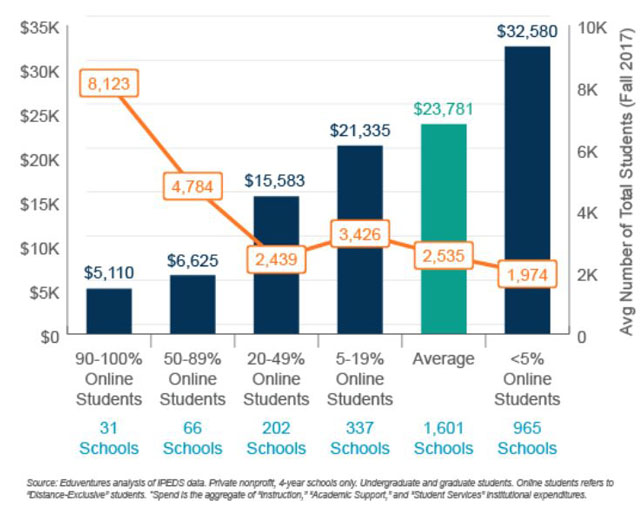
How online learning pencils out for institutional spending. The orange numbers represent the total number of fully online students in those programs. The percentages underneath the bars show the share of students within the institution who are enrolled in fully online programs. And the dollars above each bar represent the average annual cost for delivering that online program to each student. Source: Eduventures Research
Eduventures analysis of the WCET and other data found that private, nonprofit four-year schools spend an average of $23,781 per student to deliver programs to students who are fully online. That cost shrinks to $5,000 per student when the proportion of online students makes up between 90 and 100 percent of the school's total student population, and is considerably higher when the number of fully online students makes up less than 5 percent of the student population. This latter group makes up the bulk of institutions included in the analysis (60 percent).
Another data point that factors into a cost comparison between online and face-to-face programs is the rate at which students finish their undergraduate degrees, which is lower for fully online schools — "by about a third to half," wrote Garrett. Could that dramatic savings in cost-per-student make up for the larger departure of students that those schools experience? The evidence is pointing that way, he suggested, with a "steady growth in online student numbers in an otherwise flat enrollment environment." As the number of students enrolled in online programs rises, the overall costs go down per student, allowing schools to "[rein] in tuition."
Yet, at the same time, the average expenses jumped by 52 percent in fully online schools, signaling that they're trying new ways of holding onto students by improving the learner's experience. Therefore, he concluded, "more online often means higher cost."
As a result, the question about whether online learning can solve the college debt problem is still unresolved. What's needed, Garrett concluded, is a "creative [blend] of in-person and online learning" within institutions to "produce the best mix of cost reduction and high quality."
The analysis is openly available on the Encoura website.
About the Author
Dian Schaffhauser is a former senior contributing editor for 1105 Media's education publications THE Journal, Campus Technology and Spaces4Learning.