Johns Hopkins Dashboard Maps Global Coronavirus Cases
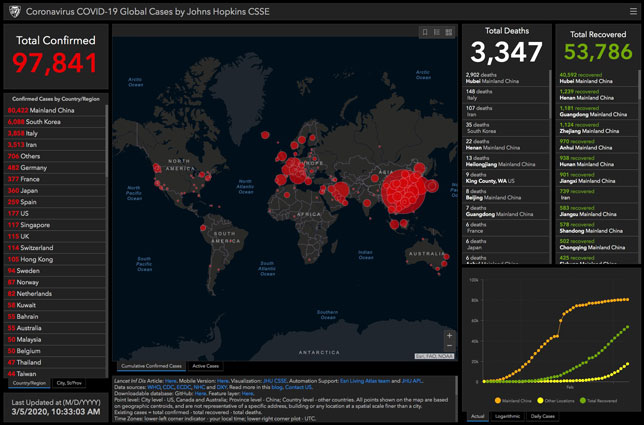
Coronavirus dashboard

Screen capture of the dashboard as of March 5, 2020

The Center for Systems Science and Engineering at Johns Hopkins University has developed an interactive, web-based dashboard that tracks the status of COVID-19 around the world. The resource provides a visualization of the "location and number of confirmed COVID-19 cases, deaths and recoveries for all affected countries," according to a university blog post.

The primary data source for the tool is DXY, a Chinese platform that "aggregates local media and government reports to provide COVID-19 cumulative case totals in near real-time at the province level in China and country level otherwise," the post explained. Additional data comes from Twitter feeds, online news services and direct communication sent through the dashboard. Johns Hopkins then confirms the case numbers with regional and local health departments.

All data from the dashboard is also freely available in a GitHub repository.

About the Author

Rhea Kelly is editor in chief for Campus Technology, THE Journal, and Spaces4Learning. She can be reached at [email protected].

Featured

  • abstract networking lines with AI text on top

    WWT, NVIDIA Introduce Framework for Secure, Scalable, Responsible AI Adoption

    Technology services provider World Wide Technology and NVIDIA have jointly developed an AI security framework dubbed AI Readiness Model for Operational Resilience (ARMOR), designed to help organizations accelerate AI adoption while maintaining security, compliance, and operational resilience.

  • stylized illustration of people conversing on headsets

    AI and Our Next Conversations in Higher Education

    Ryan Lufkin, the vice president of global strategy for Instructure, examines how the focus on AI in education will move from experimentation to accountability.

  • glowing brain above stacked coins

    The Higher Ed Playbook for AI Affordability

    Fulfilling the promise of AI in higher education does not require massive budgets or radical reinvention. By leveraging existing infrastructure, embracing edge and localized AI, collaborating across institutions, and embedding AI thoughtfully across the enterprise, universities can move from experimentation to impact.

  • workshop participants discuss sustainability in open science and research

    Open Source: Advancing Our Digital Commons

    IT leaders are recognizing the benefits of a return to open strategies. CT asked Jack Suess, VP of IT and CIO at UMBC, for his views on returning to the digital commons of open source.