IT Security: Does it make the Grade?
Straw poll finds IT security a priority in higher education—albeit an underfunded
one.
THE 2005 REPORT CARD |
| Security Element |
Grade |
| Administration Priority |
A– |
| Faculty Support |
B |
| Student Support |
C– |
| Administration Support |
B+ |
| Funding |
C |
| Staff Time |
C |
| Overall Security Profile |
B– |
| While administration and faculty commitment to IT security
earned high scores, funding and staff time allocations received lower marks,
as did student support. Source: “CDW-G
Higher Ed Security Report Card 2005.” Used with permission. |
CDW-G has released the results of its informal 2005 sampling of 102 higher
education IT professionals on the topic of IT security. In an attempt to understand
barriers to improving IT security on campus, survey questions were designed
to gauge levels of support by administration, faculty, and students for IT initiatives,
as well as to examine administrative prioritization, staffing, and funding.
Researchers assigned “grades” based on participant responses, and CDW-G issued
a “report card” for 2005.
A’s and B’s for faculty and administrators.
Among the key takeaways from the brief study is that IT security is not “counter
to the culture” in higher education: 69 percent of respondents characterized
it as a top or very high priority for administrators, 73 percent said that faculty
support security policies, and 87 percent reported that security policies are
supported by their executive administration. Clearly, IT security makes the
grade as a priority in higher education institutions.
Funding, staffing, and students get C’s or lower.
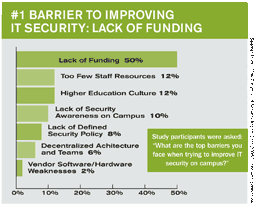
Despite the priority recognition of IT security on campus, lack of funding is
a significant barrier to improving security—identified by 50 percent of respondents
as their biggest barrier. And the organizational resource picture looks even
worse when coupled with scarcity of staff: 12 percent of respondents pointed
to “too few staff” as their own institution’s biggest barrier to security gains.
The lowest score, the C- given to student support, is in large part attributed
to lack of awareness, rather than lack of regard—a situation that’s possibly
also related to a need for more staff attention.
For the record. Organizational resource allocation
clearly did not match the high priority and recognition given to IT security
by higher education IT professionals and faculty in 2005. This year, CDW-G plans
to perform a more extensive study, following up on key findings from 2005 data.
Will the grades, particularly for funding and staffing, improve?