2007 Campus Technology Innovators: High-Tech Learning Spaces
TECHNOLOGY AREA: HIGH-TECH LEARNING SPACES
Innovator: San Jose State University
An incubator classroom offers the latest technology
so that faculty may innovate new modes of instruction
The construction of a new library on the San Jose State University (CA) campus presented a question and an opportunity:
What could be done with the old library building? The
fortuitous decision to turn the abandoned library structure into
a state-of-the-art, 10,000-square-foot Academic Success
Center sent Associate VP for Academic Technology Mary Jo
Gorney-Moreno and other campus leaders into high gear for
two years, to determine which kinds of formal and informal
learning spaces would best serve the university's unique population
of commuter students.
Extensive research. The first step in planning the new
Academic Success Center was to engage innovation and
design firm Ideo to conduct an independent
study of the campus, to find out what students, faculty, and
staff thought about the types of spaces that were needed.
Ideo performed focus groups; fly-on-the-wall observations;
man-on-the-street interviews with faculty, staff, and students;
as well as complete surveys of students and staff. For her part,
Gorney-Moreno traveled to campuses across the country to
research other high-tech learning spaces.
Key among the research findings was that learning spaces
should foster collaboration among students and faculty, and
that faculty members want teaching spaces that are flexible,
accessible, and convenient. The Academic Success Center's
final design features numerous informal, flexible spaces that
support collaboration—but it's the Incubator Classroom that
is the center's signature offering. It combines flexible classroom
furniture and configurations with an array of audiovisual
technologies designed to enable two-way, collaborative classroom
interaction.
A variety of technologies. The Incubator Classroom
scales to seat up to 50 students in different configurations and
has numerous features designed to enhance faculty/student
interactions in the classroom environment. Diverse vendors
such as CompView, Oliver Worldclass
Labs, and many others were consulted
as a rich mix of software and equipment was integrated
into the top-flight facility. Faculty quickly learned to use the
environmental and instructional control system from AMX, and conferencing systems from Polycom. The room features three screens: a large
central projection screen and two rear-projection mobile
Smart Boards on either side. Faculty
are able to display multiple pieces of information and seamlessly
mark up presentations on the fly. Hewlett-Packard tablet PCs and Apple MacBook Pros are available to every student, and all are interconnected
through a central server housed in the room.
Faculty and students can easily share information using Tidebreak's
TeamSpot collaboration software.
Instructors may also use TurningPoint student response
systems for polling and sampling
a class's level of comprehension. Software for text and
image generation, such as a suite of Adobe software, is readily available, along with a range of software
applications for collaboration and/or discipline-specific activities.
Additionally, various classroom-capture technologies
facilitate publishing of course materials and class activities
and content. Faculty and student response to the Incubator
Classroom has been overwhelmingly positive based upon survey
data and comments gathered since the facility's opening
this past academic year.
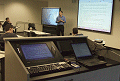
SJSU’S INCUBATOR
CLASSROOM combines
flexible classroom furniture
and configurations
with an
array of AV technologies
designed to enable two-way,
collaborative classroom
interaction.
Facilitating instructional innovations. The space is
not merely a teaching space, but also a research space:
designed for faculty to work on instructional innovations, and
demonstrate and measure their effectiveness. Faculty who
wish to teach in the Incubator Classroom submit a course proposal
outlining how they plan to utilize the tools to positively
impact student achievement. After only a single semester,
facility administrators were inundated by innovative faculty
proposals. Courses taking advantage of the Incubator Classroom
technology come from all different disciplines; some
examples include Archaeology Research, Industrial Design,
Animation and Illustration, and Science for Elementary School
Teachers. "It's been fascinating to watch faculty using the
room, and finding out where they want the controls, where students
want chairs, tables—how they want to work," says
Gorney-Moreno. By studying how each of the disciplines
leverages technologies, San Jose State is using the Incubator
Classroom space to prototype technology-enhanced classrooms
of the future.