Wirecast 4.0 Goes Pro, Adds 3D Virtual Sets
Telestream has released Wirecast 4.0, an update to the company's cross-platform, live Webcasting production suite. In its latest incarnation, Wirecast adds a Pro version to the lineup, offering enhanced graphics capabilities and expanded camera support.
Wirecast (standard and Pro editions) is designed as an alternative to hardware-based live Webcasting solutions. It acts as a desktop video production and broadcast studio, with software-based switching between video and audio sources, including cameras, files, desktop sharing (via an integrated Desktop Presenter app), microphones--essentially anything stored on or connected to a Mac OS X- or Windows-based system. It includes support for multiple layers (with live compositing), with multiple elements accessible and switchable on each layer. It also includes picture in picture, keying, 20 editable transitions, pre-designed lower thirds, and simultaneous encoding in multiple formats.
For output, Wirecast supports Flash (H.264 and VP6 with AAC audio encoding up to 48 kHz and 320 Kbps), QuickTime (with a full range of audio and video codecs, including Sorenson 3), and Windows Media. It supports recording to disk; broadcasting from a laptop or desktop directly (via built-in streaming server); and uploading to popular streaming services, such as the free Ustream and others.
Wirecast version 4.0 gets a UI overhaul and an improved shot editor and source settings editor. It also adds user-defined layers, with live compositing support for up to 35 layers. Other improvements include:
- Support for a wider range of broadcast destinations (Brightcove, and Sermon.net);
- Expanded support for professional cards from Blackmagic Design;
- Additional lower thirds; and
- Enhanced Flash encoding.
The new Pro version includes virtual scoreboards (for Webcasting sporting events or other competitions) and support for 3D virtual sets, with several pre-designed sets included. It also adds support for HDV cameras; wireless IP cameras from Sony, Cisco, and Axis; and a global audio inspector.
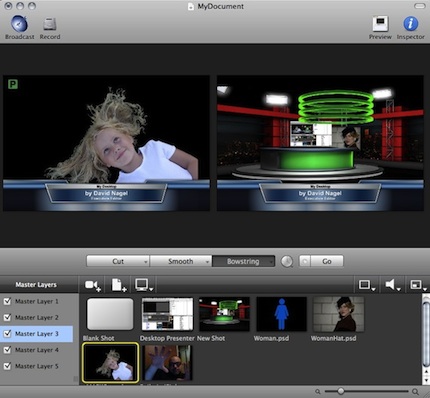 |
| Telestream Wirecast Pro supports 3D virtual sets. |
Telestream WIrecast 4.0 is available now for Mac OS X and Windows. The full version of Wirecast 4.0 is $449; Wirecast Pro sells for $995. Version 4.0 is a free update for existing customers, with an upgrade to Wirecast Pro 4.0 running $546.
There is a 10 percent discount for education customers. A free trial is also available. Further information can be found here.