Apple Unveils iPad Air, iPad Mini with Retina Display

The iPad Air
The iPad Air

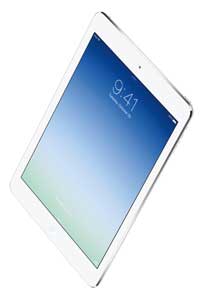
Apple has unveiled a new, lighter version of the iPad, the iPad Air, and a new iPad mini with Retina Display.

The new iPad Air sports a 9.7-inch screen with a resolution of 2,048 x 1,536 and is 28 percent lighter than the fourth-generation iPad, weighing in at 1 pound. It's also 20 percent thinner, at 7.5 mm, and has a narrower bezel.

The iPad Air is powered by the 64-bit A7 chip and includes an M7 coprocessor for handling sensor data more efficiently. It also offers dual 802.11n antennas and support for MIMO, allowing for wireless speeds of up to 300 Mbps.

Other features include:

  • Bluetooth 4.0;
  • 802.11 a/b/g/n 2.4 GHz and 5 GHz WiFi;
  • Dual cameras, one 720p and one 1080p; and
  • iOS 7.

The iPad Air will be available Nov. 1 starting at $499 for the base WiFi model with 16 GB storage and $629 for the base cellular model with 16 GB.

The iPad mini with Retina Display offers a 7.9-inch display with a resolution of 2,048 x 1,536. It too runs on the 64-bit A7 chip and includes the M7 coprocessor. And, like the iPad Air, it offers dual 802.11a/b/g/n antennas and support for MIMO.

The iPad mini with Retina display will be available in late November for $399 for the base 16 GB WiFi model or $529 for the base 16 GB cellular model.

Additional details can be found on Apple's site.

About the Author

David Nagel is the former editorial director of 1105 Media's Education Group and editor-in-chief of THE Journal, STEAM Universe, and Spaces4Learning. A 30-year publishing veteran, Nagel has led or contributed to dozens of technology, art, marketing, media, and business publications.

He can be reached at [email protected]. You can also connect with him on LinkedIn at https://www.linkedin.com/in/davidrnagel/ .


Featured

  • robots organizing stacks of papers

    An AI Adoption Imperative: Centralized Sources of Governed Truth

    Strategies for enterprise teams who aim to build a data foundation to move the institution from AI experimentation to real-world execution.

  • Neon blue security locks with a single red highlight

    AI Shifts Cybersecurity Focus from Finding Flaws to Fixing Them

    For decades, one of cybersecurity's most difficult challenges has been finding vulnerabilities before attackers do. A growing number of security professionals now say artificial intelligence is changing that equation, shifting the focus from discovering flaws to fixing them quickly enough to prevent exploitation.

  • digital data protection and cyber security

    White House Launches New AI Security Framework

    President Donald Trump has issued a new executive order aimed at maintaining United States AI leadership while addressing the security risks posed by increasingly powerful AI systems.

  • Profile silhouette of a person thoughtfully touching their chin, overlaid with transparent data visualizations and digital interface elements suggesting artificial intelligence and analytics.

    The Institutional Knowledge Shift Is Reshaping Higher Ed IT

    Higher education IT leaders are navigating a quiet but consequential transition: Experienced team members are retiring or leaving for private-sector roles, and the teams replacing them are smaller, newer, and often stretched thin. The result is a structural shift in how technology decisions are made, executed, and sustained.