Helix Education Makes LMS Platform More User-Friendly for Instructors
Helix
Education has released several new enhancements to its Helix Learning Management System (LMS) designed to allow instructors to spend less time worrying about
the "back-end" technology and more working with students.
Helix LMS is a learning management system for higher
education that focuses on competency-based formats both on-campus and
online.
The new functionalities are intended to create efficiencies involving
communication between instructors and students, grading and course
development.
| |
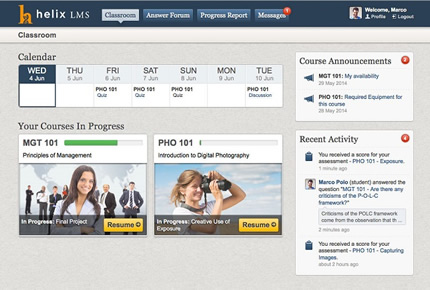
The latest version of Helix LMS is designed to allow instructors to communicate more efficiently with students. |
|
Recent improvements to the Helix platform include:
- Automated
communication
functionality that helps the instructor create his or her own
to-do list that readily adapts to the student's pace, letting faculty
know
exactly when to reach out to them with reminders. For example, a student
who is
moving through a course quickly and is close to finishing might receive
a
reminder if the student hasn't logged in for three days. On the other
hand, a
student who may be working on the course over a longer time period might
not
receive a reminder for up to seven days;
- Enhanced
grading options allow the instructor to make notes and grade
uploaded
documents from the student — like Word files, PowerPoint presentations
or PDFs
— on the documents themselves. This is designed to both make the grading process
less
laborious and time-consuming for the instructor and offer the students
the
opportunity for more feedback on their work;
- Content
repurposing will allow multiple versions of rubrics in the system
so that
instructors can link them to different assessments if they want, or to a
single
assessment if that's their choice. The added flexibility is designed to allow
faculty
to reuse the best and most appropriate rubrics without starting from
scratch
each time; and
- Finally, a complete preview mode allows
instructors and curriculum developers to view and navigate a course
exactly as
a student would, allowing them to better gauge the flow of content
through the
course from the student's perspective.
"Our goal is for both students and instructors to have a meaningful
experience," said Helix Education Senior Vice President Steve Pappageorge.
"They can't be bogged down by technology, but rather need to be able to
concentrate
fully on learning materials, activities and interaction."
About the Author
Michael Hart is a Los Angeles-based freelance writer and the former executive editor of THE Journal.