Raytheon, UMass Lowell Establish New Research Institute
Raytheon will contribute $3 million and perhaps as much as
$5 million over the next 10 years to establish a new research facility at
the University of Massachusetts Lowell.
What will be called the Raytheon-UMass
Lowell Research
Institute will allow UMass Lowell faculty and students to collaborate with
Raytheon employees on research. The initial focus will be on future
technologies for radar and communications systems, leveraging the
university's
strengths in printed electronics and nanotechnology, which coincides with
Raytheon's strategic interest in high-frequency printed conformal
antennas,
carbon-based transistors and photonic devices. In the future, the focus
may
expand into other areas as needed.
| |
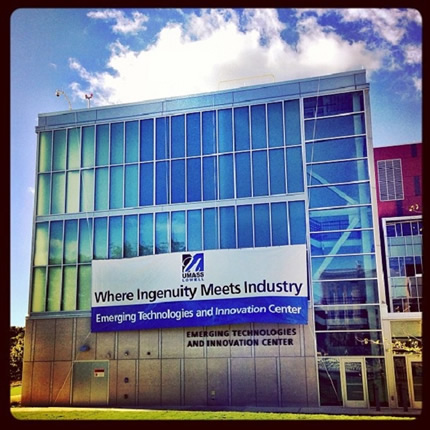
The new Raytheon-UMass Lowell Research Institute will be housed in the Mark and Elisia Saab Emerging Technologies and Innovation Center. |
|
UMass Lowell Chancellor Marty Meehan said both the
university and the company will benefit as they together pursue federal
research funding. It will serve as well as an opportunity for students to
participate in high-level research projects and possibly offer access to
career
opportunities with Raytheon.
"This institute will provide our students with the kind
of
real-world experience that is a hallmark of a UMass Lowell education,"
Meehan
said. "It is just one example of how UMass Lowell is leading the way in
collaborating
with industry to power innovation."
At the same time, said Mark E. Russell, Raytheon vice
president of engineering, technology and mission assurance, "The institute
will
serve as an extension of our current research capabilities and represents
a
resource across the Raytheon enterprise for the study of advanced
materials and
flexible circuit technologies."
The research institute will be located on the fourth
floor
of the Mark and Elisia Saab Emerging Technologies and Innovation Center,
an
84,000-square-foot building on the campus that already houses research
labs and
classrooms in the science and engineering disciplines.
Raytheon's corporate headquarters are in Waltham, MA,
about
20 miles from the university in Lowell.
The institute will be codirected by Christopher
McCarroll of
Raytheon and UMass Lowell Professor Craig Armiento.
About the Author
Michael Hart is a Los Angeles-based freelance writer and the former executive editor of THE Journal.