Penn State Teams Dominate App-Building Hackathon
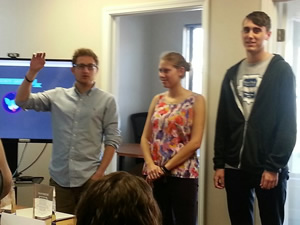 Teams from Pennsylvania State University took first and second
prizes in the first-ever Civitas
Learning Student Success Hackathon, held the
weekend of February 7-8 at the Austin, TX, headquarters of the
software-as-a-service provider.
Teams from Pennsylvania State University took first and second
prizes in the first-ever Civitas
Learning Student Success Hackathon, held the
weekend of February 7-8 at the Austin, TX, headquarters of the
software-as-a-service provider.
In the hackathon, seven teams from colleges and
universities
around the country competed — over a 24-hour period — to build apps that
would
improve student learning and success. Four teams from Texas
universities, along
with the two from Penn State and one from University of Nevada Las
Vegas,
competed.
Winning the $3,000 first prize, one of the Penn State
teams
created "Lady Bird," an app that allows students to design their own
course program
by revealing courses that match their personal interests and then
cross-referencing them with courses that would fulfill the requirements
for
their degrees.
The second prize of $2,000 went to a Penn State team
that
built "Construct," a Web site that matches students based on skills they
have or
want to develop in a project-based learning setting.
Chris Millet, the assistant director of education
technology services
at Penn State who accompanied the teams to the Austin competition, said
there
were significant benefits to the students who participated.
"I think that going into the workforce, they're going
to
have quite an advantage, having had this experience," Millet said.
"Actually,
some of these hackathons are increasingly being used by recruiters as a
way to
find talented students."
A panel of six judges evaluated the student teams'
apps.
One of the judges, Civitas
Learning Vice President of Product
Laura Malcolm, said, "This was a deep learning experience for the
students.
They just didn't pick to work on apps using skills and tools they
already knew."
About the Author
Michael Hart is a Los Angeles-based freelance writer and the former executive editor of THE Journal.