New Wearable Device Makes Any Space Interactive
The Bird, which can be attached to a user's finger, reflects the wearer's position in space, pointing direction, hand posture, voice commands and pressure levels.
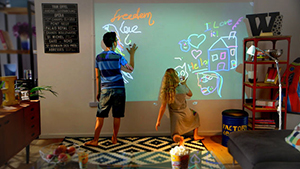
The Bird turns any surface into a touchscreen.
MUV Interactive has introduced the Bird, a device worn on the finger that can be used to make any space interactive.
The small plastic device has several sensors that can be combined with a projector or a TV and, from as far away as 25 feet, be used to manipulate any space as a touchscreen. Its algorithms integrate and analyze data from the sensors in real time, reflecting the wearer's position in space, pointing direction, hand posture, voice commands and pressure levels.
"Bird redefines the way people interact with digital media," said MUV Interactive CEO Rami Parham. "Our team has put together a miracle of engineering that not only supports today's applications, but pushes the envelope of what is possible in future ones."
Users can move or click the device, which weighs about two-thirds of an ounce.
The Bird's partner app uses several plug-ins that can function as a controller for different devices, such as smart appliances or even drones. It also has a microphone for voice-issued commands and a touch surface controlled by the user's thumb for registering swipes and taps. The Bird is compatible with any computer running on Windows or OS X, including mobile devices.
It is not necessarily the first gesture-based input device, but others — such as the Nintendo Wii, Microsoft Kinect and the Myo Gesture Control Armband — have primarily focused on gaming functions. Bird is the first one to be marketed as an educational tool.
Orders are now being accepted at a promotional price of $150. Once in full distribution, the devices will likely retail for $250.
The Bird is the first product for MUV Interactive, an Israel-based company founded in 2011.
About the Author
Michael Hart is a Los Angeles-based freelance writer and the former executive editor of THE Journal.