USC Schools of Comm and Engineering Launch Joint Informatics Master
- By Dian Schaffhauser
- 01/21/16
Two schools at the University of Southern California have joined forces to introduce a new master's degree in communication informatics. The joint degree recently introduced by the Annenberg School for Communication and Journalism and the Viterbi School of Engineering is intended to cross-prepare professionals in both disciplines.
The school partnership will also introduce "innovation teams," which will leverage technology to deliver news and storytelling in new formats.
The Master of Communication Informatics degree will cover big data, data mining and data analytics, security, virtual and augmented reality, crowdsourcing, social media and other kinds of online communities and the use of technology in journalism. For those in communications students will become familiar with the use of data and the design and construction of mobile apps, online networks and social media tools. Those in engineering will gain a better understanding about communications such as public relations and public engagement and how people interact with technology.
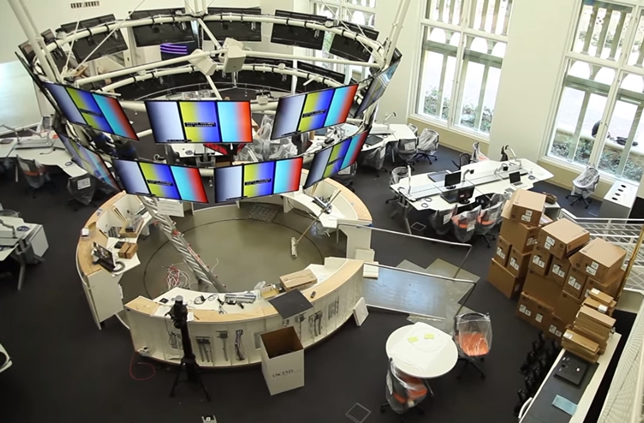
University of Southern California's converged media center is a 20,000-square-foot facility with multipurpose television, radio and direct-to-Web video broadcast studios that allow students to stream professional-caliber programming to any of those media.
The program is hosted as part of Viterbi. The degree will require a minimum of 33 units, including foundation courses as well as classes in informatics and communications.
The innovations teams will bring together student engineers and journalists to work "side-by-side" in a state-of-the-art media center that opened in 2014. The converged media center is a 20,000-square-foot facility with multipurpose television, radio and direct-to-Web video broadcast studios that allow students to stream professional-caliber programming to any of those media.
"We look at engineering and computer science as the empowering disciplines of our times, driving convergence between the sciences, the professions and the arts," said Yannis Yortsos, dean of the school of engineering, in a press release. "In our rapidly changing world, professionals in both engineering and communications need skills from both sides; they need to learn each other's languages. And the moment you have graduates with a command of both areas, you are creating some incredibly powerful individuals who know how to solve real-world challenges."
About the Author
Dian Schaffhauser is a former senior contributing editor for 1105 Media's education publications THE Journal, Campus Technology and Spaces4Learning.