TI Innovation Design Contest Winners Tackle Real-World Challenges
Three teams of engineering
students created solutions to challenges involving medicine, space and
health to
win top honors in the Texas Instruments (TI) Innovation Challenge
Design
Contest.
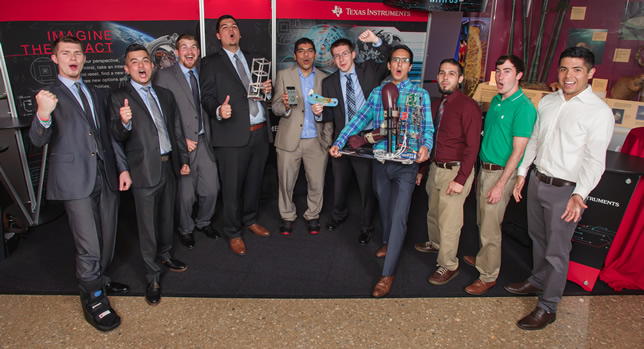
Texas A&M students won first place for creating a prototype of a space communication system that can be used to conduct low-Earth orbit research.
The three teams were tasked
with using Texas
Instruments technology to come up with their solutions.
Nearly 180 teams competed in
the contest and the three winners presented their projects to TI
executives and
judges July 19.
First place went to a team
from Texas
A&M University that created a prototype of a space
communication
system that can be used to conduct low-Earth orbit research. The team
received
$10,000 to be applied to furthering their designs or their academic
pursuits.
Another team from Texas
A&M won second place for creating a brace-like device using an
ultra-low-power microcontroller to stabilize, limit and assist elbow
movements
to restore upper arm function to people who have suffered injuries or
disorders. The second-place team received a $7,500 prize.
Finally, a team from the University
of Alabama designed a device that uses Bluetooth technology
to
wirelessly monitor a person's physical activity through the insole of
their
shoes. They received $5,000.
Each category prize winner
received $1,000. The category winners are:
"When
students marry engineering education with hands-on
creativity, they have the potential to turn their innovative prototypes
into
the next big technology that will change the world," said TI Education
Technology President Peter Balyta.
The
winners received their awards July 19 at a dinner held at the Perot
Museum of Nature and Science in Dallas after earlier in the day touring
a TI
innovation center and presenting their projects to the judges.
About the Author
Michael Hart is a Los Angeles-based freelance writer and the former executive editor of THE Journal.