Cornell Engineering Debuts Online Collaboration Space for Makers in Grades 6-12
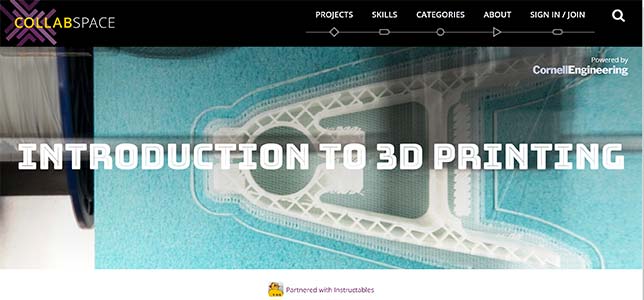
The new site offers tools for users to meet other makers, learn about engineering disciplines, share projects or meet mentors among Cornell graduate students, alumni and professors.

The college of engineering at Cornell University has launched CollabSpace, a maker-themed website for students in middle school and high school.

The new site offers tools for users to meet other makers, learn about engineering disciplines, share projects or meet mentors among Cornell graduate students, alumni and professors.

"Not sure where to go next with your project?" the site asks. "Get advice from a Cornell engineer. Want to know more about what it's like to study a specific engineering topic or work in a certain engineering field? CollabSpace will help find someone who can tell you."

The site allows users to post their own projects, either in-progress, after completion or as featuring an "awesome malfunction." Projects are searchable by 20 categories, such as 3D printing, coding or sustainability and by difficulty or discipline.

Skills feature three levels and have titles such as "Electronics Crash Course," "Cutting Metal" and "3D Printing Glossary."

"CollabSpace creators hope that middle school and high school tinkerers, coders and makers will join the site and find a community where they can learn and grow and explore various aspects of engineering," according to a Cornell news release. "They hope CollabSpace will be a place for makers of all ages to share their experiences and get feedback from one another."

For more information, visit collabspace.cornell.edu.

About the Author

Joshua Bolkan is contributing editor for Campus Technology, THE Journal and STEAM Universe. He can be reached at [email protected].

Featured

  • large group of college students sitting on an academic quad

    Student Readiness: Learning to Learn

    Melissa Loble, Instructure's chief academic officer, recommends a focus on 'readiness' as a broader concept as we try to understand how to build meaningful education experiences that can form a bridge from the university to the workplace. Here, we ask Loble what readiness is and how to offer students the ability to 'learn to learn'.

  • glowing brain above stacked coins

    The Higher Ed Playbook for AI Affordability

    Fulfilling the promise of AI in higher education does not require massive budgets or radical reinvention. By leveraging existing infrastructure, embracing edge and localized AI, collaborating across institutions, and embedding AI thoughtfully across the enterprise, universities can move from experimentation to impact.

  • row of digital padlocks

    2026 Cybersecurity Trends to Watch in Higher Education

    In an open call last month, we asked education and industry leaders for their predictions on the cybersecurity landscape for schools, districts, colleges, and universities in 2026. Here's what they told us.

  • Interface buttons of Generative AI tool

    Report: No Foolproof Method Exists for Detecting AI-Generated Media

    Microsoft has released a new research report warning that no single technology can reliably distinguish AI-generated content from authentic media, and that deepening reliance on any one method risks misleading the public.