COVID-19 Wreaks Havoc on High Schooler College Plans
- By Dian Schaffhauser
- 12/14/20
Due to changes in
education wrought by COVID-19, the number of 2020 high school
graduates who went to college immediately this fall dropped by nearly
22 percent compared to 2019 graduates, almost eight times the
pre-pandemic loss rate of 2.8 percent. The decrease occurred across
the board, in all kinds of high schools. But the decline hit high-poverty schools the hardest, where college enrollment dropped by
nearly twice as much as higher income schools.
The
analysis was undertaken by the National
Student Clearinghouse Research Center
in its eighth annual "High
School Benchmarks"
report. This year's report included a special analysis of the impact
of COVID-19 on college progression rates. The research examined
preliminary data from high schools and colleges reporting as of
Sept. 18, 2020 from the Clearinghouse's StudentTracker
for High Schools
service. The "immediate" enrollment rates were estimated
for graduates from some 2,300 high schools with differing income,
minority and setting characteristics.
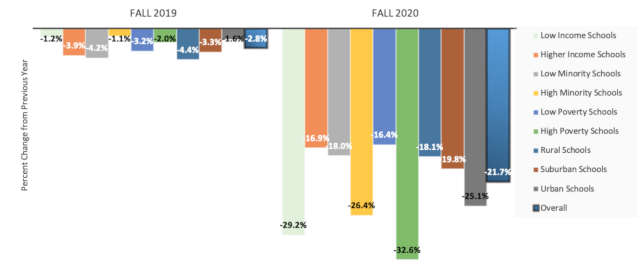
Change
in the number of students enrolling in college after school, brokenout by high school characteristics. Source: "High
School Benchmarks"
from the National Student Clearinghouse Research Center
The
study found that the pandemic struck college enrollment rates
considerably for graduates of high-poverty, low-income, high-minority
and urban high schools, which saw declines of 32.6 percent, 29.2
percent, 26.4 percent and 25.1 percent, respectively.
For
those high schoolers who may or may not have attended college, the
immediate college enrollment rate fell to 27.7 percent in 2020 from
35.3 percent for 2019, a decline pegged as "10 times steeper"
than last fall's drop (from 35.9 percent in 2018 to 35.3 percent in
2019). A disproportionate share of the impact was made by students
from low-income high schools, where the decline was 29.2 percent,
compared to 16.9 percent for their peers in higher-income high
schools.
"Based
on preliminary data, there is little evidence that COVID-19 impacted
high school graduation," noted Doug Shapiro, executive director
of the center, in a statement. "However, the pandemic impacted
high school graduates in their immediate college enrollment, and
those from high-poverty, low-income and urban high schools have been
hit the hardest. The enrollment gaps appear to be widening because of
COVID-19."
The
full high school benchmark report is available on
the NSC Research Center site.
About the Author
Dian Schaffhauser is a former senior contributing editor for 1105 Media's education publications THE Journal, Campus Technology and Spaces4Learning.