FIRE Launches Online First Amendment Library
- By Dian Schaffhauser
- 11/16/16
The First Amendment of the United States Constitution contains 45 words and references five freedoms: religion, speech, press, assembly and petition. Yet, according to a survey done by the Newseum earlier this year among 1,008 Americans, 39 percent couldn't list any of the five. When asked whether students on college campuses specifically should be allowed to say whatever they wanted, 57 percent of respondents agreed with the sentiment of free speech, and 40 percent disagreed. The count among conservatives who agreed was higher (66 percent) than among liberals (62 percent); moderates were about evenly divided (52 percent).
Now an organization dedicated to defending the rights of students, staff and faculty on college campuses has launched its own online library with the goal of helping "the public's understanding of the First Amendment."
The Foundation for Individual Rights in Education (FIRE) said it created the "First Amendment Library" for use by anyone — students, attorneys, law clerks, judges, journalists — who wants to learn more about the amendment.
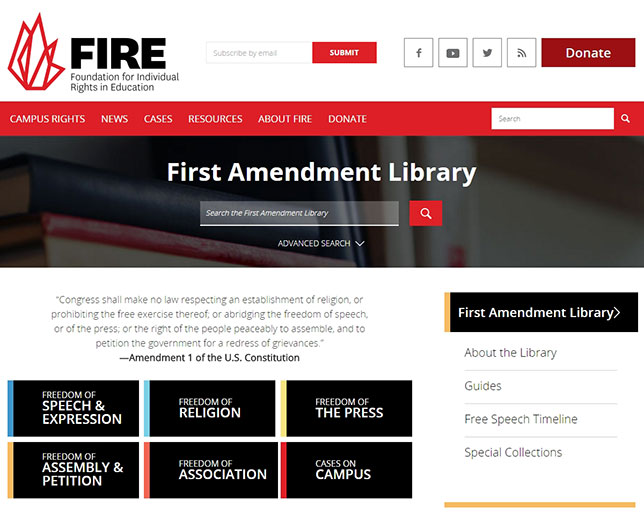
Contents include:
- A database of 900 Supreme Court cases dealing with First Amendment issues, which will expand as the court continues taking cases;
- A collection of documents, academic articles and law review articles — both historic and related to the philosophy of law; for example, the library features transcripts from comedian Lenny Bruce's obscenity trials in San Francisco, Beverly Hills, Chicago and New York;
- Sections dedicated to each of the five freedoms protected under the First Amendment, with coverage of influential Supreme Court decisions, documents and other content to help readers understand the topics; and
- An interactive timeline laying out the history of free speech, beginning with the recognition of the Magna Carta by England's King John in 1215.
Eventually, the library will include a First Amendment encyclopedia aimed at the layperson, including K–12 students.
"Our hope is that the library will generate more interest in and respect for the First Amendment. In that regard, the library is a work in progress, replete with revisions, corrections, updates and expansions," stated Ronald Collins, a scholar the University of Washington School of Law and former fellow at the First Amendment Center in Washington, D.C. on the website introducing the new library. "The initial launch is a modest sample of will come in the months and years to come."
About the Author
Dian Schaffhauser is a former senior contributing editor for 1105 Media's education publications THE Journal, Campus Technology and Spaces4Learning.