Indiana U Bloomington Rolls Out Digital Signage Across Campus
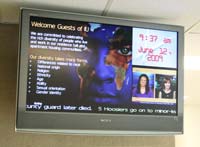

Indiana University is using Scala's digital signage system across its Bloomington campus.

Indiana University Bloomington has rolled out a digital signage system across its entire campus, including all dorms, as well as eating areas, the student union, and other locations.

The digital signage system, powered by digital signage software from Scala, is being used to broadcast news and information to staff and students. The system was completed this last semester and includes 30 individual 40-inch LCD displays. Scala partner Digital AV assisted Indiana University Bloomington's Auxiliary IT Services in the deployment.

"Digital media is not only modern and eye-catching to students, but it's less of a hassle than printed materials," said Aaron Sudduth, senior system administrator of Auxiliary IT Services. "It's evident that the marketing departments have been able to reduce the cost of printing, and the real return has been on getting information to students and staff much faster."

Using the Scala Content Manager, users can upload content to the systems using a Web browser. Content is housed in a Microsoft SQL database.

According to information released by Scala, "Using Scala software on the university network, IU Auxiliary IT now has the ability to drive more than 30 channels of individualized content to numerous screens all across campus. Currently, LCD monitors are located in all 12 campus dormitories, food service areas, parking operations and the IU Memorial Union Building. Additionally, one digital signage channel is tied directly to the TV cable network within the Memorial Union hotel to display meeting announcements and other upcoming events in each meeting room."

In the future, according to information released by Scala, the digital signage system may also be integrated with Bloomington's emergency alert system.

Indiana University Bloomington serves roughly 39,000 students. The Indiana University system, with eight campuses around the state, serves nearly 100,000 students.

About the Author

David Nagel is the former editorial director of 1105 Media's Education Group and editor-in-chief of THE Journal, STEAM Universe, and Spaces4Learning. A 30-year publishing veteran, Nagel has led or contributed to dozens of technology, art, marketing, media, and business publications.

He can be reached at [email protected]. You can also connect with him on LinkedIn at https://www.linkedin.com/in/davidrnagel/ .


Featured

  • Image of digital screen with data and math formulas on black background

    AI Giants Report Advances in Mathematical Research

    OpenAI has published what it says is an AI-generated solution to the Navier-Stokes existence and smoothness problem, one of mathematics' seven Millennium Prize Problems, while Anthropic has reported separate advances in research mathematics and formal proof generation.

  • Jason Palm

    AI, Identity, and Speed: Cybersecurity Priorities for Higher Ed

    Fortinet Security Operations Specialist Jason Palm explains how AI is raising new security challenges for higher education, requiring stronger governance, identity protection, threat detection, automation, and incident readiness.

  • artificial intelligence on laptop

    OpenAI to Combine AI Products into Desktop 'Superapp'

    OpenAI is reportedly developing a desktop application that would combine several of its emerging AI products into a single platform, according to reports, marking the latest step in the company's effort to transform ChatGPT from a standalone chatbot into a broader productivity and automation environment.

  • Hootsuite

    Beyond the Feed: How Higher Ed Turns Social Media Into a Measurable Enrollment Engine

    More than half of prospective students research programs on social media before visiting a university website, and nearly half will skip applying to a school that looks inactive online. Hootsuite, the all-in-one social OS platform trusted by more than 2,000 higher education institutions, helps campus teams turn everyday posts into measurable outcomes, from applications to alumni giving.