Panasonic Launches Ruggedized Android, Windows 8 Tablets
Panasonic is rolling out two new high-end, ruggedized tablets--a 10.1-inch model running Windows 8 Pro on a Core i5 processor and a 7-inch Android machine.
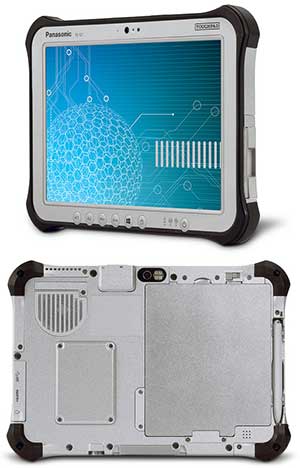
The Toughpad FZ-G1 boasts a resolution of 1,920 x 1.200 and has a brightness rating of 800 cd/m². |
At the 2013 International CES, taking place this week, Panasonic debuted the Toughpad FZ-G1, a 10.1-inch Windows 8 Pro tablet built on a third-generation, 1.9 GHz, dual-core Intel Core i5-3437U vPro processor. Its screen boasts a resolution of 1,920 x 1.200 (WUXGA) and has a brightness rating of 800 cd/m². It comes equipped with 4 GB to 8 GB RAM and solid state storage in capacities ranging from 128 GB to 256 GB, with support for optional micro SDXC removable storage.
Other specs include:
- Eight-hour battery life;
- Bluetooth 4.0;
- Wireless 802.11 a/b/g/n;
- 4G LTE or 3G (optional);
- Wired LAN port;
- USB 3.0 port and USB 2.0 port (full-size);
- HDMI output; and
- Option of "true serial port or dedicated GPS."
The ruggedized touchpad device (MIL-STD-810G, IP65, 4-foot drop, 14°F to 122°F operating range) measures 10.6" x 7.4" x 0.75" and weighs in at 2.43 pounds.
The 7-inch Panasonic Toughpad JT-B1 is the second ruggedized Android 4.0 tablet in Panasonic's Toughpad line. (It joins a previously released 10.1-inch model, the Toughpad FZ-A1). The JT-B1 sports a dual-core, 1.5 GHz Texas Instruments OMAP4460 CPU, 1 GB RAM, 16 GB ROM (according to specs issued by Panasonic), and a micro SDHC slot. Its display has a resolution of 1,024 x 600 (WSVGA) with a brightness of 500 cd/m².
Other features include:
- Eight-hour battery life;
- Bluetooth 4.0;
- Wireless 802.11 a/b/g/n;
- 4G LTE or 3G (optional);
- Micro USB;
- Front-mounted, 1.3 megapixel, fixed-focus camera; and
- Rear-mounted, 13 megapixel, autofocus camera and LED light.
Like the FZ-G1, the JT-B1 is ruggedized (MIL-STD-810G, IP65, 5-foot drop, 14°F to 122°F operating range). It measures 8.7" x 5.1" x 0.7" and weighs 1.2 pounds.
The Panasonic Toughpad FZ-G1 is expected to ship in March. It will start at $2,899. The Android-based Toughpad JT-B1 is expected in February. It will start at $1,199. Additional details can be found on Panasonic's Toughpad portal.