MakerBot Intros Platform for Experimental Projects
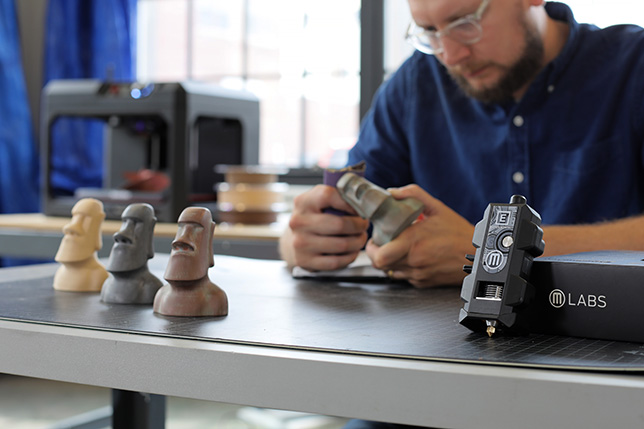
Photo: Business Wire

A new offering from MakerBot aims to serve as an experimental platform for creating, building, innovating and collaborating with 3D printing. MakerBot Labs is a sandbox for designers and engineers that includes customizable hardware and software with open APIs, custom print nodes and more.

"We're introducing this new, more open platform as a direct response to our advanced users calling for greater freedom with materials and software," explained MakerBot CEO Nadav Goshen in a statement.

The first products available on the platform include:

  • MakerBot Labs Experimental Extruder, a customizable extruder with four interchangeable nozzles, such as a large-diameter draft nozzle (for "draft" printing at higher speeds) and a stainless steel nozzle (for printing in abrasive materials);
  • Custom print modes in MakerBot Print, allowing users to import and export print setting configurations for various materials and objectives;
  • MakerBot Labs Community on Thingiverse, a hub for users to collaborate, discuss techniques and share resources like custom material print modes, custom hardware mods, new apps and software APIs; and
  • MakerBot Labs API, giving developers the means to interface with and expand the capabilities of MakerBot 3D printers.

For more information, visit the MakerBot site.

About the Author

Rhea Kelly is editor in chief for Campus Technology, THE Journal, and Spaces4Learning. She can be reached at [email protected].

Featured

  • VSLive! session

    VSLive! San Diego 2026 Puts AI at the Core of the Campus IT Stack

    For higher education IT teams working through AI pilots, ERP integrations, student-facing apps, analytics projects, and mounting security concerns, Visual Studio Live! San Diego 2026 offers a look at the development practices that are shaping the campus technology landscape.

  • networked node grid featuring illuminated connectors

    Infrastructure Accounts for More than Half of Worldwide AI Spending

    Gartner forecasts worldwide AI spending will reach $2.67 trillion in 2026, up 49.5% from 2025, with AI infrastructure accounting for nearly $1.5 trillion, or about 56% of the total. For every dollar Gartner expects to be spent on generative AI models, more than $52 will be spent on infrastructure.

  • digital brain integrating legal regulation and security interface

    Agentic AI Moves from Pilot Phase to Production, Bringing Governance to the Forefront

    New research from Caylent, an AI-focused Amazon Web Services Premier Tier Services Partner, found that enterprises are already moving agentic AI beyond pilots and into production environments. At the same time, organizations are putting strict conditions around autonomy, making governance and control the next major challenge for enterprise AI adoption.

  • lock symbol with quantum bits in dynamic motion

    Microsoft Accelerates Focus on Quantum-Safe Security

    Microsoft is speeding up its quantum-safe security timeline, saying advances in quantum computing and new federal requirements have pushed post-quantum cryptography from a future planning issue into an immediate engineering priority.