Smart Assistants Helping to Drive Growth of Wearables
Wearable devices will continue to see healthy growth over the next
five years, driven by new use cases, new devices and the rise of smart
assistants.
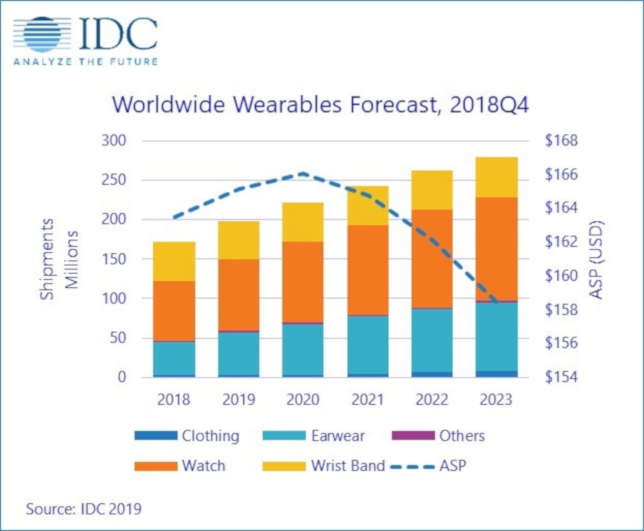
According to a new report released by IDC, wearables will increase 15.3
percent worldwide in 2019 compared with 2018, with 198.5 million units
expected to be shipped this year. IDC forecast smaller but still
substantial annual growth (8.9 percent) through 2023, when shipments are
expected to hit 279 million units.
Watches made up 44.2 percent of shipments in 2018 and are expected to
account for an even larger percentage of the market by 2023, 47.1 percent.
But headsets/ear-worn devices will have a major impact on that growth with
the rise of smart assistants, reaching 31 percent of the market by 2023.
"The rise of smart assistants on wearables, both wrist-worn and ear-worn,
is a trend worth watching," said Jitesh Ubrani, research manager for IDC's Mobile
Device Trackers, in a prepared statement. "Though still in its infancy,
the integration of these assistants with wearables opens up new use cases,
from allowing these devices to tie into the smart home to making the
devices more proactive at urging users to live healthier or more
productive lives."
"Two major drivers for the wearables market are healthcare and enterprise
adoption," said Ramon
T. Llamas, research director for IDC's Wearables team, also in a
prepared statement. "Wearables stand to play an important role in digital
health, constantly collecting important patient data while also giving
patients the ability to self-monitor. Within the enterprise, wearables can
help to accelerate companies' digital transformation by transmitting
information back and forth while allowing workers to complete their tasks
faster. This is where both vendors and companies can streamline processes
to achieve faster results."